Short answer
When your AC is not cooling, check the thermostat — set to COOL with a setpoint below room temperature — then inspect the air filter, breaker, and outdoor unit for debris or a frozen coil. These checks fix many no-cooling calls. If it still will not cool, or you see ice or smell burning, call a licensed HVAC pro.
The 5-minute no-cooling checklist
Most no-cooling calls are resolved by simple checks you can do safely in five minutes. Work through them in order before assuming the system is broken — a surprising number of 'dead' air conditioners just need a setting corrected or a filter changed.
If at any point you smell burning, see sparking, or find water pouring where it should not be, stop the checklist and call a professional. Those are not DIY symptoms.
- Thermostat: set to COOL, setpoint several degrees below room temperature, fan on AUTO.
- Air filter: pull it out — if you cannot see light through it, replace it.
- Breaker: confirm the indoor (air handler/furnace) and outdoor (condenser) breakers are ON.
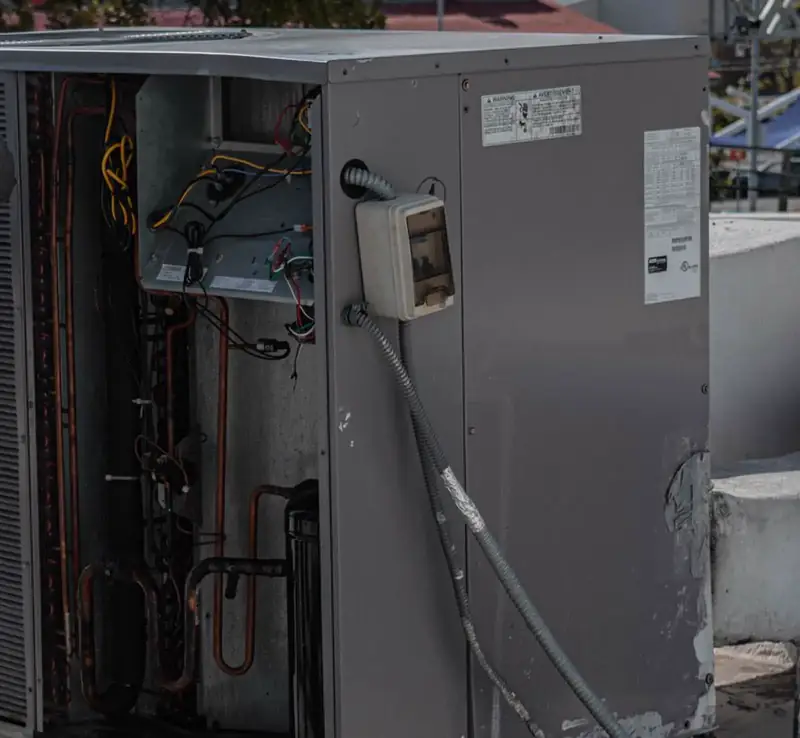
- Outdoor unit: clear leaves, grass clippings, and debris from around it; nothing within two feet.
- Supply vents: open and unblocked — closed vents in unused rooms can unbalance the system.
- Condensate: if the indoor unit has a full drain pan or a tripped float switch, the system shuts down to prevent flooding.
Thermostat: the usual suspect
Thermostat mix-ups cause a remarkable share of no-cooling calls. The mode may have been bumped to HEAT or FAN during seasonal changeover, the setpoint raised by another household member, or the program schedule overriding your manual setting. Confirm COOL mode, a setpoint below the current room temperature, and the fan on AUTO rather than ON — constant fan circulates air without cooling it.
If the thermostat screen is blank, it may have lost power: dead batteries in battery models, a tripped breaker, or a blown low-voltage fuse at the air handler. Replace batteries first, then check the breaker. A blank smart thermostat after a power outage sometimes just needs to be reseated on its base.
Airflow killers: filters, coils, and debris
An air conditioner cools by moving air across a cold indoor coil. Anything that chokes that airflow — a clogged filter, a coil matted with dust, closed supply vents, a blocked return grille — reduces cooling capacity and can eventually freeze the coil solid. If your system is running but barely cooling, airflow is suspect number one.
Replace a dirty filter with the correct size and type (check the arrow for airflow direction). Vacuum dust from return grilles, and walk the house opening every supply vent — furniture, rugs, and curtains block more vents than homeowners realize. Outside, rinse grass and cottonwood fluff off the condenser coil with a gentle hose spray from the outside in, with the power off at the disconnect.
Ice on the coil? Stop and thaw
If you see ice on the indoor coil, the refrigerant lines, or the outdoor unit in summer, turn the system to OFF (or FAN only) and let it thaw completely — this can take several hours. Running a frozen system does not cool the house; it risks damaging the compressor, the most expensive part in the system.
Once thawed, replace the filter and make sure vents are open, then try cooling again. If it freezes a second time, stop — repeat freezing points to low refrigerant or a deeper airflow problem, both of which need a licensed technician. Never chip at ice with tools; the coil fins and refrigerant lines are easily punctured.
What a technician checks on a no-cooling visit
When the simple checks do not fix it, a technician works systematically: refrigerant pressures and temperatures (low refrigerant means a leak to find, not just a top-off), the capacitor and contactor that start the compressor and fan motors, the condensate drain and float switch, ductwork for disconnections or crushing, and the compressor itself.
Refrigerant, sealed-system work, and high-voltage electrical are licensed-pro territory — federal law restricts who can handle refrigerants, and capacitors store a dangerous charge even with power off. Describe what you already checked when you call; it helps the technician arrive with the right parts. AirFlow HVAC is a free referral service: we share your details with up to three independent local HVAC pros so they can contact you, and you work directly with the pro you choose.